Sunday, January 30, 2011

Winter Ascent of Nanhu Mountain

Wo pah luh Nanhu Shan. I climbed Nanhu Mountain. It was a four day hike that covered about 55 kilometers and took me to the summit of four mountains. The mountains are very steep and rugged in Taiwan so I estimate that we climbed about 5000 vertical meters or about 16,000 feet.


This is the sunrise on our first day a few kilometers into the trip. We will be waking up at 5:30 AM for the next four days to make the most of the day light.
 This is Syue or Snow Mountain. I climbed it last winter. There are pictures on this blog.

 Snow Mountain to the left with the Sacred Ridge running to the right side of the frame. The Sacred Ridge is a difficult and technical route that will "turn boys into men and girls into women." I hope to climb it someday.
 There are several National Parks in Taiwan. Nanhu Mountain is located in Taroko National Park. Taroko National Park is know for the steep river gorges that lead to the Phillipine Sea on the east side of Taiwan, but it is also home to many spectacular mountains like Nanhu.
 Another shot of Snow Mountain and the Sacred Ridge.
 The sea of clouds that is quite common in Taiwan. The proximity of the ocean makes this sight common from my climbing experience in Taiwan.
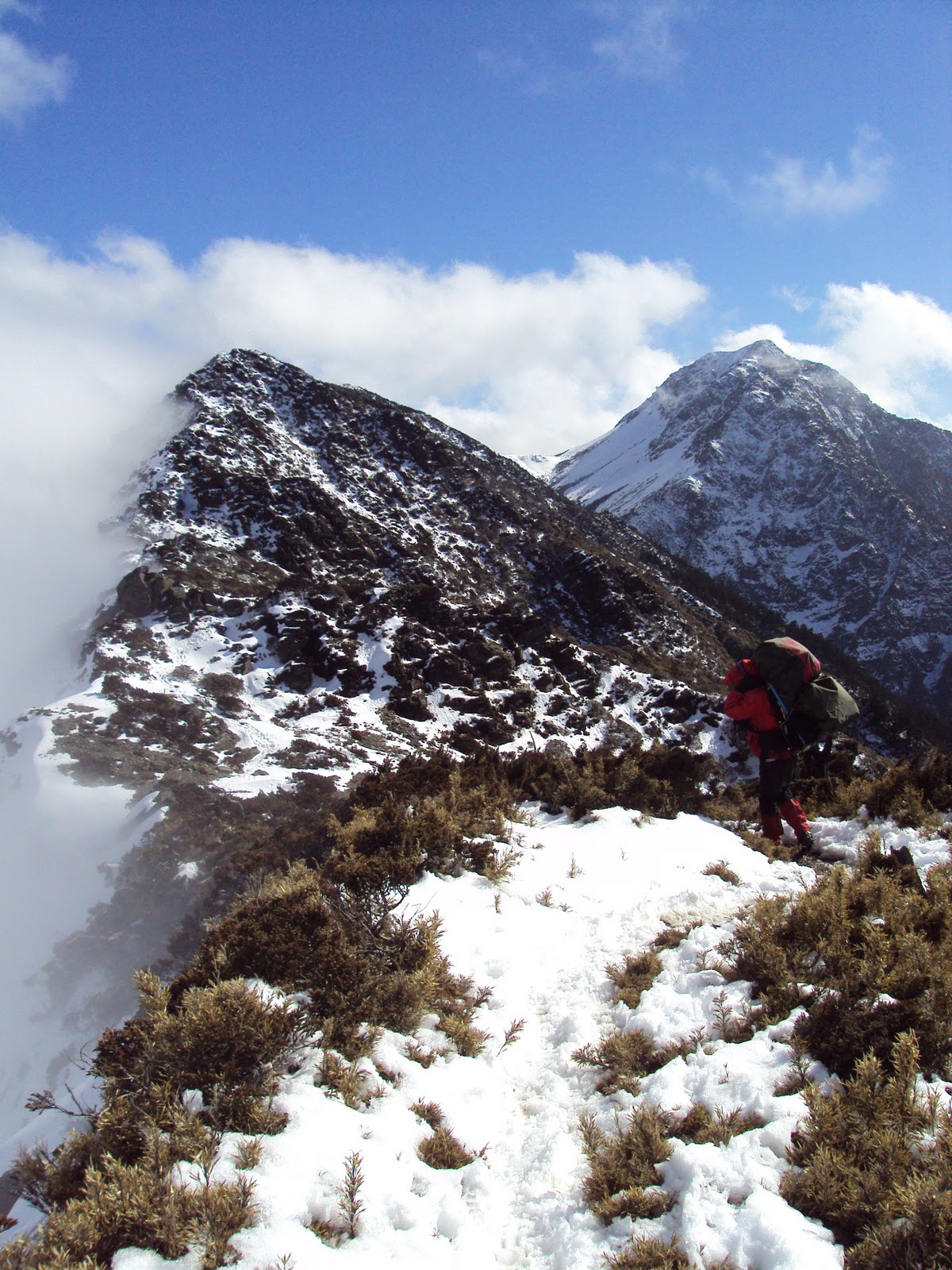
 That is Nanhu Main Peak on the right side of the frame, but, like most mountain hiking, the direct route is not always easier or even possible. We will follow that undulating ridge to the left of Nanhu before we drop about 1000 feet to the cabin at the base of the mountain. Of course, we will have to climb out of that basin and back along that ridge to get back to the van (after climbing Nanhu Main and Nanhu East Peaks...a very long and strenuous day).
 A minor peak on our first day and on our way to the first cabin. I'm not sure if it has a name, but it had a number. We climbed about 1000 meters (or 3000 feet) at this point.
 The first cabin about 12 kilometers and 1000 meters into the hike.
 The next morning starts with a steep and arduous climb through the forest up to the ridge that will lead us to Nanhu Basin. Yes, this is the trail through the forest.
 Ah, out of the forest and making our way up to the ridge where the hiking will turn to climbing and things will start to get exciting.
 The ridge leading to Nanhu Basin. That is Nanhu Main Peak on the left.
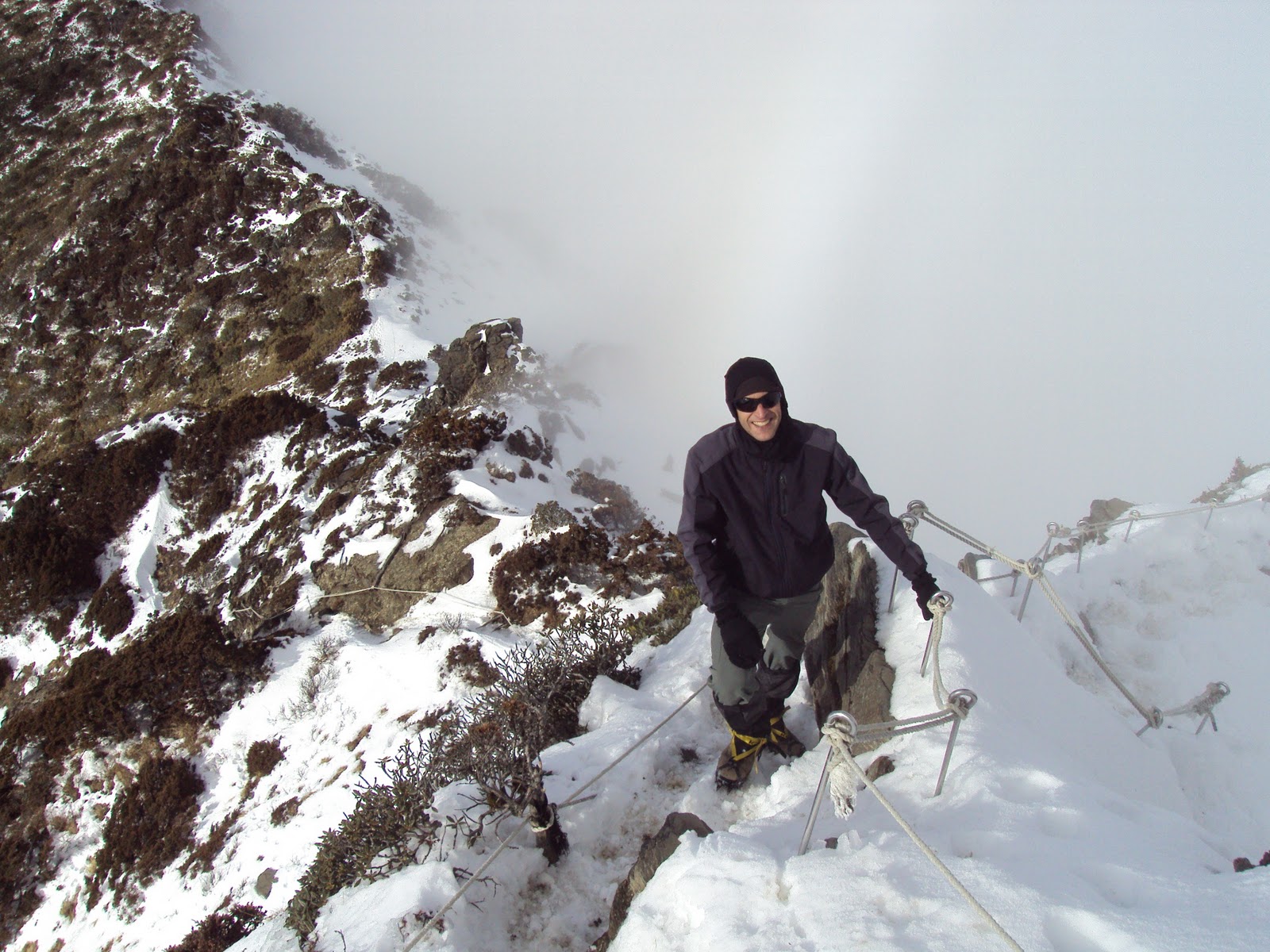
 This is where things get exciting. We have put on our crampons (bing zhou) and there are some fixed ropes, but there are moments of exposure that require focus and fortitude.
 There are strong winds blowing over the top of Nanhu and the ridge that are making clouds that trail off to the north-west.
This is a steeper section of the ridge with some fixed ropes
 I am a very happy climber.
 The sun was making rainbows in the clouds trailing off the ridge. The clouds were so close and thick you could see our shadows on them. Our heads were shrouded with small rainbow halos. It was amazingly beautiful!

 That is Nanhu Basin. You can see our cabin down in the valley. Tomorrow morning we will hike up the broad gully in the middle of the picture and then take a left to follow the ridge of Nanhu up to the summit.
 On our way up the gully with the sunrise and the moon over Nanhu Shan.
 Starting our climb up to the ridge of Nanhu with the sea of clouds roiling below us.


 This was the crux near the summit of Nanhu Main Peak. It was a short technical section with a lot of exposure. If you slip and fall the wrong way you're tumbling down the mountain.
 That's the ridge we came across yesterday (and we'll hike back over it after lunch today). We've come a long way.
 On the summit of Nanhu Main Peak at 3742 meters or 12,276 feet. I've been living close to sea level for almost a year and half so the air feels quite thin. Even when I lived in Colorado I would notice the effects of high altitude. I had trouble sleeping the night before our ascent which is quite common when people ascend to high altitudes.
 My climbing partners on the summit of Nanhu Main Peak.
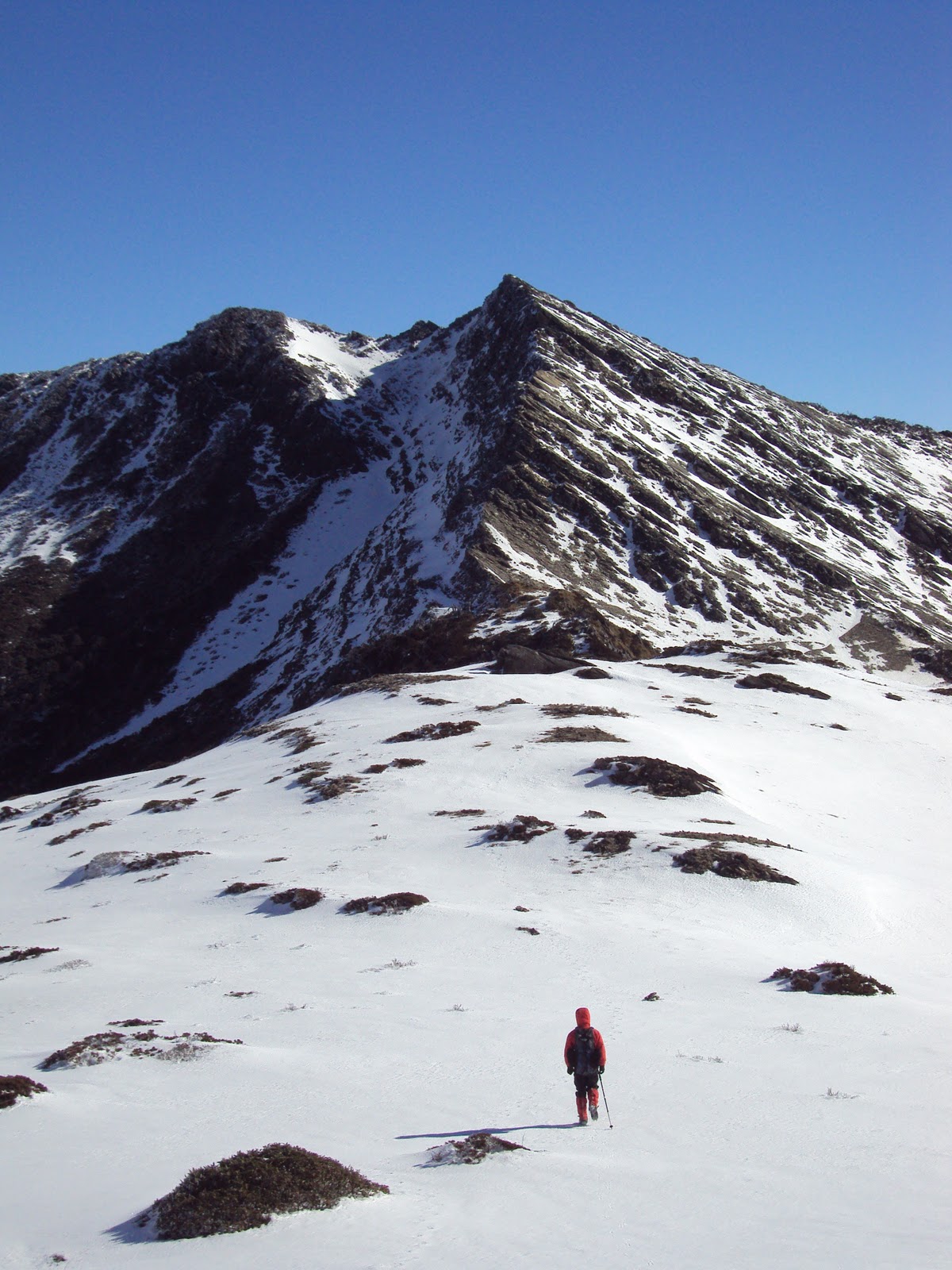
 That long 'wedge' is Nanhu East Peak. The guide and I will do a quick ascent of it next.


 A mountaineers main tool are crampons or bing zhou.
 Heading for Nanhu East Peak. We will follow a narrow shelf to the right and then make a hard left and follow a broad couloir up to the summit. I will use my ice axe for this ascent.
 The broad couloir up the the summit of Nanhu East Peak. It's not too steep and the exposure isn't bad either, but I'm still using my ice axe.

 On the summit of Nanhu East Peak
 My guide on near the summit of Nanhu East Peak with Nanhu Main Peak.
 Nanhu Main Peak from the summit of Nanhu East Peak
The high cabin in the Nanhu Basin

A short video from the rugged ridge leading to Nanhu Basin. You can really get a sense of how the sea of clouds can surround you in the high mountains of Taiwan. It really makes you feel like you're on top of the world.


A short video from the summit of Nanhu East Peak.

Wednesday, December 29, 2010

Calligraphy Class At Chun-An

We had a calligraphy class at Chun-An this afternoon. I drew about half of the class with my right hand because I thought it was the proper way to do it. When I asked the teacher if it was okay to use my left hand she was surprised. She thought I was doing well with my right hand. It is a lot harder than it looks. Creating the correct proportions is difficult enough, but it also requires a steady and even stroke to create a good line.


I drew these with my left hand.


This is the one I drew with my right hand before I realized it was okay to use my left.

Sunday, December 26, 2010

Where Has The Time Gone?

I've been very bad about posting this year. Since I am teaching in Taichung city this year there are many more distractions. I have joined a World Gym, which is something I never saw myself doing, and even hired a personal trainer for a few weeks. I'm playing an open mic regularly and getting some really good feedback. Last week I had a lovely woman say, "I love your voice"  and her gracious boyfriend ask, "What are you drinking?" I'm not sure which I liked better. I'm writing some of my own songs but I also cover music from Beck, The Beatles, Neil Young, Bob Dylan, and others. I'm also trying to learn some Taiwanese songs like Kan Guo Lai http://www.youtube.com/watch?v=7OxZ4x-mqSg.  I recently I joined a running and hiking club called the Taichung Hash House Harriers. There are 'Hash' clubs all over the country but this is the link to the Hash Club in Taichung http://www.taichunghash.com/. Here are some pictures from my 'virgin' hash last week.

 The beer stop about 6km into the 10km route

 It was a watery trail


Saturday, December 25, 2010

Christmas Party In My Apartment Building

 There's piano, Christmas tree, lights, and carols in Taiwanese. It's almost like Christmas in the US.
 This is the outside of my building. I'm surprised they didn't put lights on the 'Thinker'.
This is one of the doormen in my building. He's really friendly guy.

Sports Day At Hui-Lai Elementary School

You should watch this! Have I mentioned how much they love fireworks in Taiwan. This video is a perfect illustration of their love. The tossing of the sandals is funny too.


 Some of my third graders
 More third graders
 This is one of my fourth grade classes
 This is the other fourth grade class
 One of my fifth grade classes

 The mothers cheerleading squad. It's true.
 Some of my fifth grade gangsters
The teachers vs. the parents in tug-of-war. The parents won.

Wednesday, December 8, 2010

Sports Day At Chun-An Elementary School

All the schools in Taiwan have Sports Day. They dance, play games, and run races. The Sports Day at Chun-An was on a Saturday morning. Parents and teachers compete in some games too. The game I got in on was carry the ping pong ball with chop sticks and run through an obstacle course. They also have a tug-of-war where it's the teachers versus the parents. It's good fun. I think America could use this kind of healthy competition between parents and teachers. Plus, the kids have a blast and they love getting prizes for running in the races. Every student gets a prize, but the classes in each grade also run a relay race for bragging rights.


Tuesday, November 30, 2010

Too Much Of A Good Thing

This year I've been living in Taichung City and although I like being closer to foreigners and foreign food it's becoming too much of a good thing. For one thing, foreign food is more expensive so my wallet feels lighter than when I lived in Wuchi. But, perhaps, the biggest issue is that I'm missing out on the Taiwanese culture. I'm not practicing Chinese as I surround myself with foreigners and Taiwanese people who want to learn English. Also, the predominately younger foreign crowd is well, let's just say immature and running fast. In addition, the foreign crowd tends to be filled with malcontents. Yeah, they may put on a smile and act happy, especially after kicking a few back, but the stress of living in a foreign country is there in them. I don't care who you are. You are going to feel it. It's natural and I speak from personal experience. Once the group psychology gets going the manifestation of this stress can be quite strong if you are sensitive to it. I didn't really notice it until I visited some teachers in Wuchi. Most foreigners never notice it because they never leave the comfort circle of familiarity. There is something to be said for 'easing into new waters', but eventually you just have to jump in and swim. So, how does that translate into action for me? Buy a bicycle and join a cycling club. Find a Taiwanese hiking and mountaineering club. Learn Chinese and spend my free time in places where I can use it. Learn some Taiwanese songs so my time playing guitar in the park may generate some contact and maybe conversation. I'm sure I will come up with more ideas, but I'm glad that I've had this realization. I know it will make my experience in Taiwan richer and more enjoyable.

Sunday, November 7, 2010

Teaching At Chun-An and Aboriginal Cultures

I'm teaching at two elementary schools this year. I teach two days at Hui-Lai and three days at Chun-An. Chun-An is a very interesting school. The demographics are more diverse than Hui-Lai. There are a lot of aboriginal (Paiwan) students that go to school at Chun-An. In fact, there is a Paiwanese teacher that teaches their language to the students. Taiwan has made some very strong efforts to support and retain their aboriginal cultures. It has not always been this way, but they recognize the value of this cultural heritage. The recognized tribal groups of Taiwan are the Ami, Atayal, Bunun, Kavalan, Paiwan, Puyuma, Rukai, Saisiyat, Tao, Thoa, Tsou, Truku, Sakizaya, and the Sediq.

The school is going through some big changes right now. They have built a new school, but some classes are still being held in the old school. The old school will be torn down this year and another new wing will be built where the old school is.


This is the old school that will be torn down.

 The sixth graders playing T-ball.
 There are signs everywhere encouraging students to learn English.


 This is my classroom in the old school. I will move to the new school this year, but then I will not have my own classroom. I will have to move to each homeroom.

 This is the new wing at Chun-An. Once they tear down the old school they will build another wing where the old school is now.

Teaching At Hui-Lai

Hui-Lai is a new elementary school in Taichung city. The facilities are excellent. They have a small English Village in the school. An English Village is a great opportunity for the kids to practice their English in role-plays using props and mock situations. Hui-Lai was visited by some teachers from the UK last week who were doing research on technology in the classroom. They were very impressed with school.

This is my wonderful classroom.
This is the hallway outside of my classroom. Happy, smiling animals to greet me every morning.
This is another view of my classroom. You can see the various stations of the English Village.


My desk with the Smart Board, projector, and white board. The Smart Board is basically a large interactive screen. I can project the screen from the computer onto the Smart Board and interact with it just like I would on my computer. We have interactive textbooks that I can put on the Smart Board too. I like the Smart Board a lot, but I still use flashcards and the white board.